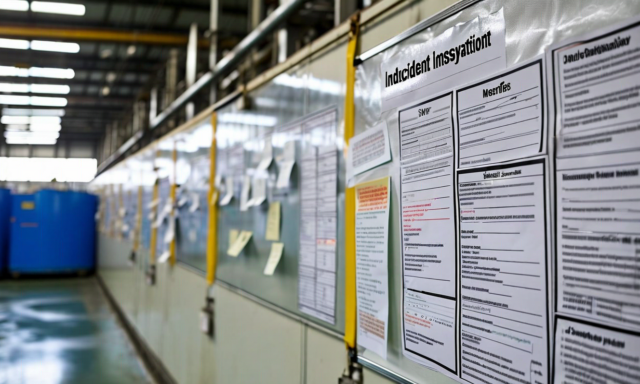
Near-miss reporting is one of the most consistently endorsed leading indicators in industrial safety. The theoretical case is clear: incidents do not happen without preceding chains of near-misses and hazard accumulation. Capture those signals early, and you prevent the injury at the end of the chain. This logic drives the launch of near-miss programs at thousands of manufacturing facilities each year. It also explains why so many of those programs fail, because the theory assumes that workers will report near-misses at a rate high enough to generate useful signal, and that assumption is almost never validated against the actual organizational conditions at a specific plant.
The pattern of decline is consistent enough to describe with reasonable confidence. Near-miss submission rates are highest in the first three months of a program, when novelty, management visibility, and initial training all reinforce participation. By month six, submission rates typically drop 40 to 60 percent from the launch peak. By month 18, most programs are receiving two to five reports per month at facilities that should, based on near-miss frequency research, be generating dozens of reportable events weekly across their workforce.
The Four Failure Modes That Kill Near-Miss Programs
Based on incident data and EHS program reviews at manufacturing clients, near-miss program failures cluster into four categories. They rarely occur in isolation - the same facility that has a broken feedback loop usually also has a blame-culture problem - but understanding them separately clarifies where intervention is most effective.
Blame culture persisting despite policy change. Near-miss reporting requires workers to voluntarily disclose events in which they or their colleagues either caused a hazardous condition or came close to an injury. If the organizational response to that disclosure, even in the absence of an explicit punishment policy, involves additional scrutiny, supervisor attention, or social friction with coworkers, participation will decline regardless of what the written reporting policy says. Workers are accurate judges of actual consequences even when formal policy describes different ones.
No visible response to submitted reports. The most common mechanical reason for program failure is the absence of feedback to reporters. Workers who submit a near-miss report and receive no acknowledgment - no communication about whether it was reviewed, whether a corrective action was initiated, or whether the condition was resolved - conclude that the reports go nowhere. The rational response is to stop submitting. Facilities that close out near-miss reports without communicating the outcome to the reporting worker destroy the participation incentive in proportion to their operational efficiency.
Ambiguity about what qualifies as a near-miss. Near-miss definitions vary significantly across organizations, and many workers default to a narrow definition that requires actual physical contact or an immediately obvious near-injury event. Under that definition, a chemical splash that missed, a trip that was caught, or a machine that stopped unexpectedly without causing injury might not be reported. Effective near-miss programs invest time in calibration exercises that teach workers to recognize a broader category of unplanned events, including hazard observations that did not produce an immediate near-miss, as worth reporting.
Reporting friction that exceeds perceived benefit. Near-miss forms that require five minutes to complete, supervisor sign-off before submission, or detailed injury descriptions for events that did not produce an injury create friction disproportionate to the perceived value of reporting. Workers perform a rough cost-benefit calculation every time they consider submitting a report. When reporting friction is high and feedback is low, the calculation consistently resolves against submission.
The Safety Culture Index: What Near-Miss Rate Actually Tells You
An often-misunderstood aspect of near-miss reporting metrics is that a higher submission rate is nearly always a positive signal, even when it looks alarming to management. Facilities that transition from low near-miss reporting to high near-miss reporting have not become more dangerous. They have become more transparent about the hazard conditions that were always present. The organizations that should be most concerned about their safety programs are those with near-miss rates that appear low by comparison with similar facilities, not those with high rates.
This counterintuitive dynamic is captured in safety culture indices that weight leading indicators more heavily than lagging ones. A facility's RIR and DART rate reflect past injuries. Its near-miss submission rate, toolbox talk participation rate, and corrective action closure rate reflect current organizational health. Safety managers who use near-miss data correctly treat a rising submission rate as evidence of an improving safety culture rather than a deteriorating one.
Digital Reporting Tools: Faster Submission, Same Culture Problem
The shift from paper-based to digital near-miss reporting has solved the friction problem for most facilities that have made the transition. Mobile apps with two-tap submission and photo attachment reduce per-report completion time from five minutes to under 90 seconds. Submission rates typically increase 20 to 35 percent when digital tools replace paper-based ones. But the same research shows that this gain erodes within six months if the culture and feedback problems are not addressed simultaneously.
Technology reduces friction. It does not change the consequence calculation that workers apply when deciding whether to report. A facility with a blame culture and a mobile near-miss app will have a higher initial submission rate than one with a paper form, but the trajectory of decline will be similar. The only near-miss programs that sustain high submission rates long-term are those in which the organizational response to reports is consistently visible, appreciative, and operationally meaningful.
What a Functioning Near-Miss Feedback Loop Looks Like
Facilities that sustain near-miss submission rates at meaningful levels share a common structural feature: the feedback loop between submission and visible outcome is short and reliable. Reports are acknowledged within 24 hours. Corrective actions are initiated for hazard reports within 48 to 72 hours. Workers who submit reports see evidence of action - a repair, a procedural change, a toolbox talk addressing the reported condition - within their normal shift rotation.
Some facilities formalize this with a near-miss leaderboard that tracks submissions by department without identifying individual reporters, creating positive social competition around reporting rates. Others use weekly safety meetings to read near-miss reports aloud and describe the corrective action taken. The specific mechanism matters less than the consistency: workers need to see, repeatedly and predictably, that reports produce results.
As discussed in our article on leading versus lagging safety indicators, near-miss data is most valuable when it feeds a broader leading indicator tracking system rather than standing alone as a metric. Submission volume means little without analysis of the types of near-misses, the work areas generating them, and the corrective action closure rate. SafeSiteX's incident prediction engine ingests near-miss data alongside OSHA 300 logs and sensor data to surface the patterns that precede recordable incidents, making each report part of an analytical system rather than a documentation archive.
Reviving a Failing Program: Intervention Points That Work
For EHS managers facing declining near-miss submission rates, a few evidence-based interventions have track records of reversing the trend. The first is a direct conversation with workers - not about the importance of reporting, which they have likely heard, but about what has prevented them from reporting. Workers who can articulate specific barriers are giving the program what it needs to fix itself. Treat those conversations as diagnostic data.
The second intervention is a commitment to visible corrective action within a defined timeframe. Announce that every near-miss report submitted in the next 30 days will receive a written response within five business days describing either the corrective action taken or the reason no action was warranted. Then follow through with 100% consistency. Workers who receive responses to reports they had previously submitted without acknowledgment will update their calculation about whether reporting is worth the effort.
The third intervention is simplification. Review your current near-miss form and remove every field that is not strictly necessary for hazard description and location. If the form takes more than two minutes to complete, it is too long. If supervisor approval is required before submission, eliminate it. Reporting friction is a solvable problem, and solving it buys you the time to address the culture issues that matter more.
Near-miss programs that work are not complicated. They are consistent. The facilities with the highest sustained submission rates are typically not those with the most sophisticated analytical infrastructure - they are those where every worker in the building can give the same answer to the question: "What happens when you report a near-miss here?" The answer needs to be "someone listens and something gets fixed." Everything else is operational detail.
To learn how SafeSiteX supports near-miss tracking and corrective action closure, contact our team at [email protected].